

Courgettes.
The glut is now on! Plus, my recipe for a 30-minute Courgette Pasta e Fagioli.
Welcome to ingredient, where once a month I take a deep dive into some of my favourite seasonal and store cupboard ingredients. This month I’m focusing on courgettes: one of my favourite summer vegetables and very much the subject of glut recipe hunting for those of us who grow our own.

My first recipe this month is, actually, the result of having lots of half jars of chickpeas leftover from last month’s Chickpea, Halloumi & Vermicelli Stew. It’s sort of a Pasta e Fagioli in that is has soft of beans and nice, flavourful pieces of soup pasta (in this case pleasingly round rings of Sicilian anelletti) that have cooked absorbing all the cooking flavours right in the pan, but it is also very much a thick courgette stew that properly showcases my favourite way of courgettes: slowly cooking them in a pan of good olive oil with a couple of bashed garlic cloves and some salt until coloured, savoury, but also very, addictively sweet.
Later in the month I’ve got a lovely recipe for barbecued courgettes coming up, as well as a courgette risotto recipe with a slightly unexpected ingredient (which is also found in abundance at this time of year) which brings everything together on the plate / in the bowl nicely.
If someone has shared this post with you (please thank them for me!) and you’re not already a subscriber, do hit the button below so you don’t miss out! And if you fancy exploring the archives for more seasonal inspiration, we’ve not had an August post for a couple of years, but way back in the archives we were looking at another excellent summer vegetable that benefits from slow cooking, the humble aubergine:

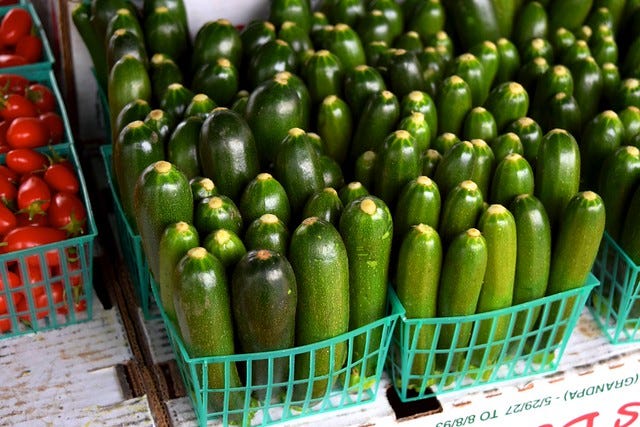
As tomatoes are technically a fruit, until I started researching this feature I thought I got to call courgettes my favourite summer vegetable, until I discovered that they’re fruit too.

They can be grated, and either tossed raw with a zingy dressing, fried into fritters, stirred into risotto, or baked into cakes and other bakes like my Courgette and Halloumi Scones. Thinly sliced (either into rings or vegetable peeler ribbons) they can be again used raw in salads, steamed as a side dish, or layered onto hot honey and lemon halloumi skewers. The healthy eating lobby got hold of them to spiralise and turn into ‘noodles’, in my mind a delicious side dish or an excellent technique to visually add interest to a noodle bowl, but not a decent substitute for the noodles themselves. Courgettes can be hollowed out, stuffed and roasted, chopped and either oven baked until golden or pan fried until collapsed and caramelised before being tossed with pasta or beans, or served as a puree or dip. Halved down the middle and treated with plenty of olive oil and salt they’re great on the barbecue, and they also make a rather good chutney or spread. Even their flowers can be stuffed, baked or fried, sometimes together.


I know people complain about courgette gluts, but for me a courgette glut is one of the best summer problems to have. And because they’re so easy for even the most novice gardeners to grow an abundance of, the only thing you really need to worry about is either going on holiday or courgettes hiding under the giant leaves and becoming a marrow, which will still be delicious, but more moisture-filled and seedy so better for preparations where you’re cooking your courgette low-and-slow.
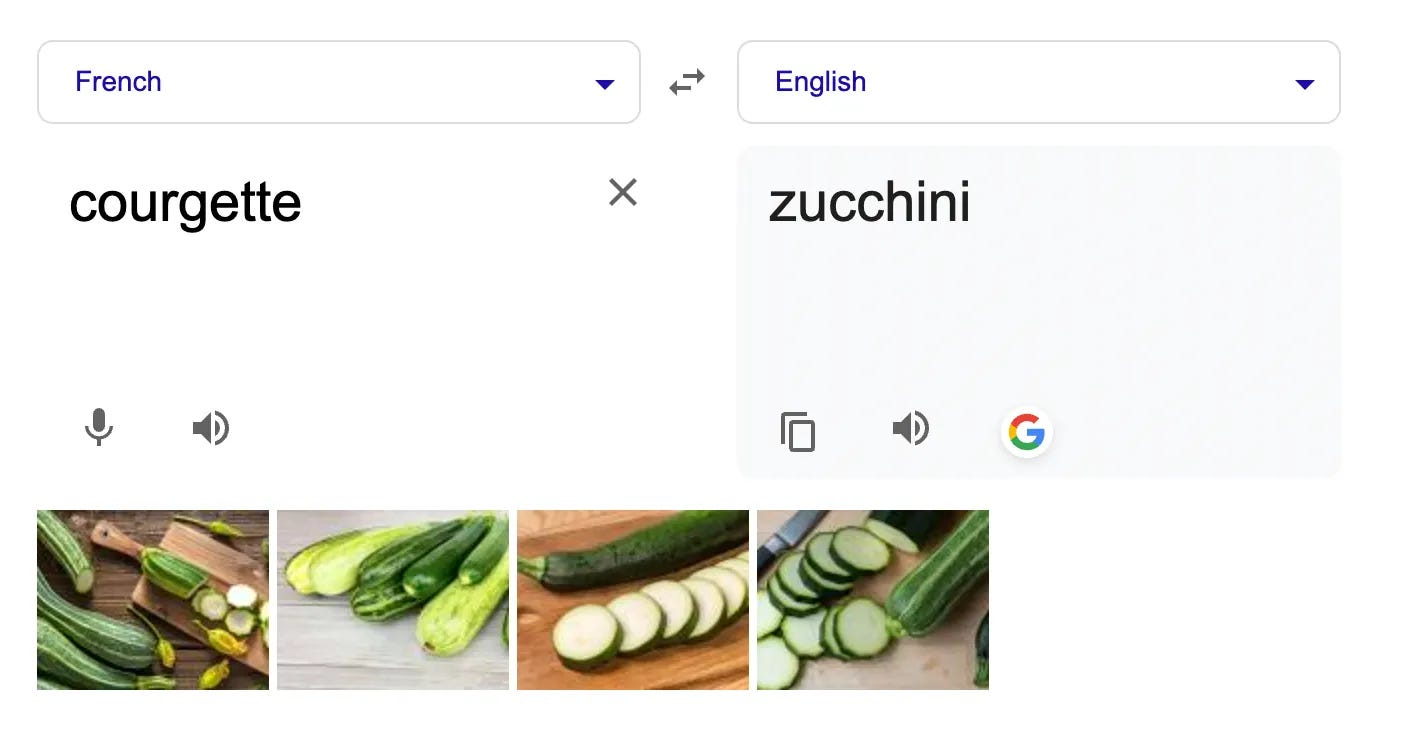
My American readers will recognise a courgette as a zucchini, and yellow courgettes as a summer squash, regardless of what Google’s AI says (though, the French do call a courgette ‘La Courgette’, I’m sorry but zucchini is American English, not English. And yes, my location is set to the United Kingdom, not the USA!) All of the courgettes most of us recognise are dark green, light green and stripy, yellow, or a mixture thereof, and are either long and thin with a slight fatness at the base, or round and globe-shaped. But, there are other varieties out there such as the Sicilian cucuzza which are very long, thin and mild. I grew some last year (a bit trickier than usual courgettes due to having to accommodate the fruit - and they’re nowhere near as plentiful) after discovering in the market in Palermo last spring. Their leaves (tenerumi) are also excellent as a spring-summer green, especially in a soup as we enjoyed it on an olive oil and almond farm near Palma di Montechiaro.


With their roots in cubits from the Americas, there are records of ‘zucchini’ being cultivated in Italy from around the 19th century, and America at the start of the 20th. They were an expensive import here in the UK until the 1950s when they were cultivated, to the point where they’re just a big of a part of our summer tables now as they are on the Continent. This explains why so many preparations of them on British tables either have Italian, French or American roots, with a few further afield recipes from places like Greece and the Middle East thrown in for good measure.

Pasta e Fagioli is an Italian soup of pasta and beans with many, many variants. These variants are a good thing, because I’m taking a fair few liberties with the concept in order to call this soupy stew-like preparation of chickpeas, courgettes and pasta Pasta e Fagioli. But fundamentally it is a really delicious vegetarian / vegan (depending on your topping preference - crunchy seasoned breadcrumbs are also allowed!) thing to make for dinner when you have a bit of time for stirring (and by a bit of time I only mean 25 minutes, this is still a 30-minute meal), which really shows off how good courgettes taste when they’re allowed to colour and soften in some good, garlicky oil.
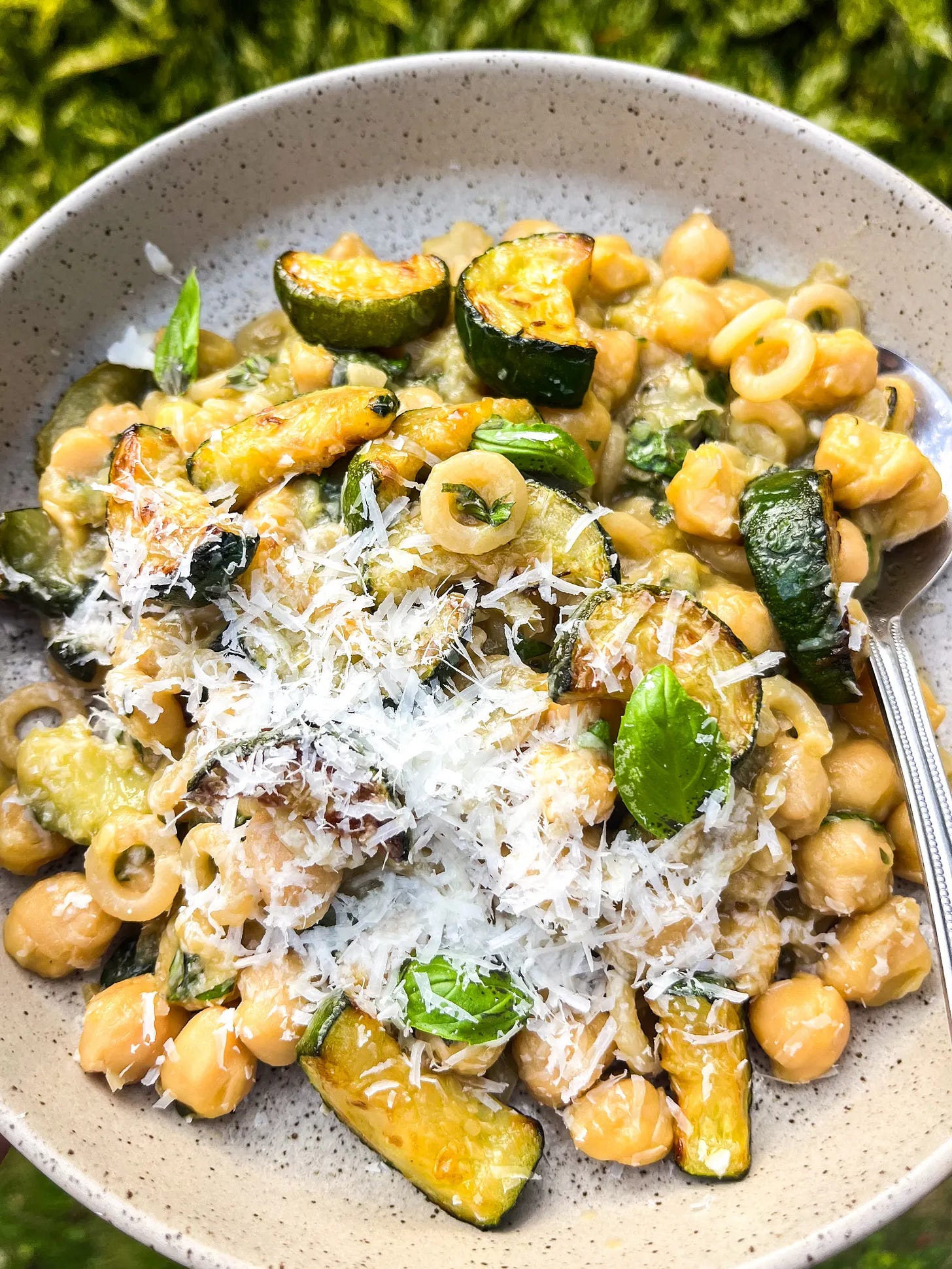
Courgette Pasta e Fagioli
Serves 2, Preparation time: 5 minutes, Cooking time: 25 minutes
This is one of those recipes you can easily feel your way through. If you want it soupy, add more liquid or simply cook things down less once the pasta is tender. Go with whatever small shape you fancy, or even pieces of broken up spaghetti from the bottom of the jar. Of course yellow courgette will also work here, as will jarred white beans if chickpeas are not necessarily your vibe.
2 large courgettes
4 large garlic cloves
very generous glug extra virgin olive oil
sea salt
60g small pasta shapes
1 x 570g jar queen chickpeas
handful fresh basil, roughly chopped
pecorino, to serve
Trim the courgettes and cut them into relatively thick half moons. Peel the garlic cloves and lightly bash them under the flat edge of your knife to let their flavours out a bit.
Add the oil and garlic cloves to a large frying pan or shallow casserole dish set over a medium heat. Once the garlic has started to sizzle, add the courgette with a very generous pinch of salt. Cook, stirring often, for 15 minutes until the courgette is soft and golden in parts. Don’t worry that the garlic cloves will become brown and crisp, they’re for infusing the oil only!
Remove the garlic cloves and 1/3 of the courgette from the pan. Throw away the garlic cloves, and set the courgette aside.
Stir in the pasta and cook for a minute or two until well coated in the oil. Follow with the jar of chickpeas (plus their bean stock) and 300ml water. Cook over the same medium heat, stirring often, for 10 minutes until the pasta is just tender, the courgettes have started to break down and the liquid is thick and soupy. Keep adding water (up to 600ml) if the pan looks dry and to get your desired ‘soup or stew’ consistency’. The exact amount you need will depend on your preference, and the type and brand of pasta you’re using.
Taste to see if it needs any more salt before stirring in the basil and serving in warmed bowls topped with pecorino.